2. Trésor des Vosges du Nord : De château en château étape 2 : d'Obersteinbach à Lembach
 Club Vosgien
3 points of interest

Entrée d'une salle troglodyte - PNRVN - A. Serylo  Castle-church-abbey
Wegelnburg fortified Chateau
Built at an altitude of 572 m, this ruin, first mentioned in 1247, is the highest in the Palatinate. After a robber knight attacking passers-by took shelter here, the castle was besieged in 1270 and illegitimately taken by the Fleckensteins. The castle changed hands frequently from 1330 onwards, before losing its military role and becoming a bailiff's residence in the 15th century. Plundered by Croatian soldiers in 1635, burned in 1644, it was finally destroyed by Montclar in 1680.
Château de Hohenbourg - A. Dorschner Castle-church-abbeyHohenbourg fortified Chateau
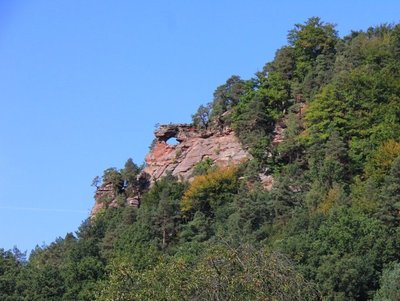
This semi-troglodyte castle built in, above and around a rock at an altitude of 550 m dates from the 13th century. Attacked twice in the 15th century, the new owners built important defensive works. But the castle was largely destroyed during a siege in 1523. It was rebuilt between 1571 and 1590 but was definitively destroyed by the troops of Montclar in 1680. The castle offers a magnificent view of the Palatinate to the north and the Steinbach valley to the south.
Château de Loewenstein - T. Bichler Castle-church-abbeyLoewenstein fortified Chateau
Built at the end of the 12th century at an altitude of 530 m and 300 m from the Hohenbourg, then ceded to the Ochsensteins, the castle became a den of robber knights before being besieged and destroyed by the troops of the Lichtenbergs and the bishop of Strasbourg in 1386. It was not rebuilt. Today, few remains remain except for traces of a pentagonal keep and a dwelling on the northern part, a cistern serving as access to the southern part, a spiral staircase and a well.
Forecast
Biodiversity around this trek
Altimetric profile
Sensitive areas
A quiet zone is not a legally mandated area; rather, it refers to areas considered conducive to the activities of sensitive species that have a critical need for quiet (feeding, migration, reproduction, giving birth, raising young, hibernation, and seeking mates).
Adopt the 5 “Quiétude Attitude” best practices and help preserve the peace and quiet of wildlife!
No. 1 I familiarize myself with quiet zones and the regulations
No. 2 I stay on marked trails
No. 3 I respect the silence of nature
No. 4 I keep my pet on a leash
No. 5 I prioritize daytime activities
The “Quiétude Attitude” program raises public awareness about the best practices to follow in natural environments to preserve the tranquility of animal species.
Translated with DeepL.com (free version)
- Impacted practices:
- Aerial, , Underground, Land, Vertical
- Sensitivity periods:
- JanFebMarAprMayJunJulAugSepOctNovDec
- Contact:
Contact : Parc naturel régional des Vosges du Nord
Maison du Parc / Château de La Petite-Pierre
2, place du château | 67 290 La Petite-Pierre
+33 (0)3 88 01 49 59
contact@parc-vosges-nord.fr
Report a problem or an error
If you have found an error on this page or if you have noticed any problems during your hike, please report them to us here: