1. Trésor des Vosges du Nord : De château en château étape 1 : de Lembach à Obersteinbach
 Club Vosgien
5 points of interest

Château fort de Froensbourg - SYCOPARC  Castle-church-abbey
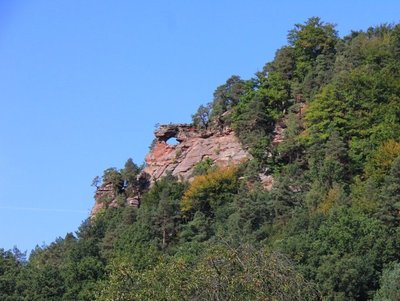
Froensbourg Chateau
Built in the 13th century, destroyed by Lichtenberg's troops in 1359 and then completely restored in the 15th century by the lords of Fleckenstein, the semi-troglodytic castle is built on two 40 m high rocks. Today, one can see rooms dug into the rock, an old cistern, an old square cistern as well as the remains of a residential tower whose broken arch door dates from 1481.
SYCOPARC  Climbing: authorized site
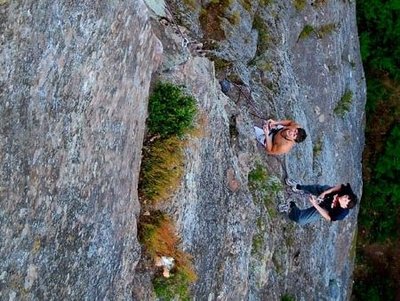
Escalade : rocher du Froensbourg
Rock equipped and agreed for the practice of climbing with appropriate equipment unless otherwise indicated on site. This agreement was elaborated in accordance with the charter for the practice of climbing on the rocks of the Vosges du Nord Regional Nature Park (http://www.parc-vosges-nord.fr/medias/File/_doc_dyn/french/charte_escalade_20081223308490.pdf and http://www.parc-vosges-nord.fr/medias/File/_doc_dyn/french/livret_escalade_compo-escalade1223300156.pdf).
Before going to the site to climb, please read the temporary restrictions at the following address: http://www.escalade-alsace.com/forum/weblog_entry.php?e=509
In any case, please follow the information on the site.

Abri du Hichtenbach - http://www.refuges.info  Refuge-shelters
Hichtenbach refuge

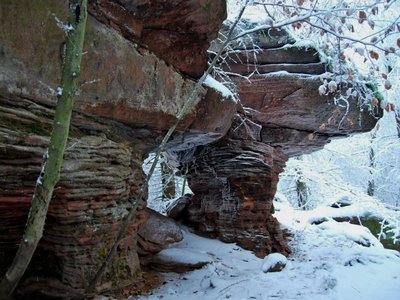
Les rochers glacés de l'Arnsberg - Guy Schnell - http://www.randoalsacevosges.com  Geology
Rocher de l'Arnsberg

Château fort de Petit-Arnsbourg - SYCOPARC Castle-church-abbeyPetit-Arnsbourg fortified Chateau
Mentioned for the first time in 1316, it belonged to the abbey of Wissembourg and to the family of Wasigenstein. Passing from hand to hand, its last owners were the Hanau-Lichtenberg family between 1604 and 1606. It was destroyed during the Thirty Years War in 1635. Isolated at the top of a hill, it was equipped with a wooden structure allowing to gain on the void and to widen the dwellings. One of the doors, carved in the rock, with a double frame, bears the date of 1494. More information here and there.
Forecast
Biodiversity around this trek
Altimetric profile
Sensitive areas
A quiet zone is not a legally mandated area; rather, it refers to areas considered conducive to the activities of sensitive species that have a critical need for quiet (feeding, migration, reproduction, giving birth, raising young, hibernation, and seeking mates).
Adopt the 5 “Quiétude Attitude” best practices and help preserve the peace and quiet of wildlife!
No. 1 I familiarize myself with quiet zones and the regulations
No. 2 I stay on marked trails
No. 3 I respect the silence of nature
No. 4 I keep my pet on a leash
No. 5 I prioritize daytime activities
The “Quiétude Attitude” program raises public awareness about the best practices to follow in natural environments to preserve the tranquility of animal species.
Translated with DeepL.com (free version)
- Impacted practices:
- Aerial, , Underground, Land, Vertical
- Sensitivity periods:
- JanFebMarAprMayJunJulAugSepOctNovDec
- Contact:
Contact : Parc naturel régional des Vosges du Nord
Maison du Parc / Château de La Petite-Pierre
2, place du château | 67 290 La Petite-Pierre
+33 (0)3 88 01 49 59
contact@parc-vosges-nord.fr
Report a problem or an error
If you have found an error on this page or if you have noticed any problems during your hike, please report them to us here: