
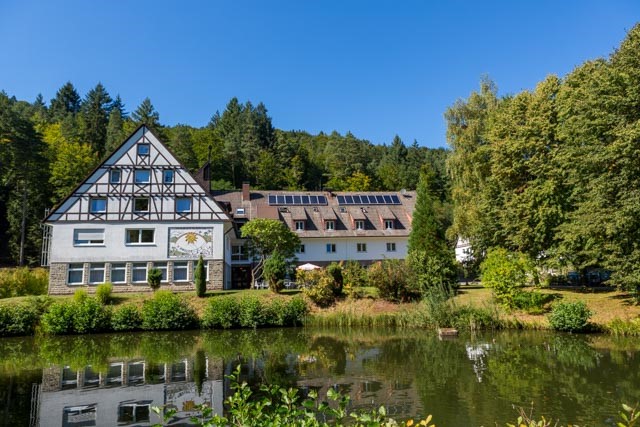
bildungs-und-freizeitstaette-heilsbach
Lembach

Embed this item to access it offline
The route passes through picturesque valleys and the Pfälzerwald Biosphere Reserve, which is a UNESCO World Biosphere Reserve. Pfälzerwald/Northern Vosges. The villages on either side of this loop offer a wide variety of landscapes.

Description

From Lembach, the cycle path leads along the Sauerbach stream. Past the campsite and the Fleckensteiner Weiher (bathing opportunity), the route runs along the D925 for a short distance until it turns left after the pond on an asphalt cycle path towards Hirschtal and on to Schönau. From there, the route leads past the Königsweiher pond in the direction of the Heilsbach education and leisure centre. We then turn right here and cross the wooden bridge of the Königsbruch. We continue on the water-bound cycle path slightly uphill to the Rumbacher-Höhe, then we ride downhill towards Rumbach. Arriving in the idyllic half-timbered village of Rumbach, we follow the cycle path to Bundenthal. We pass the Falkenmühle mill and cross the village of Bundenthal. At the end of the village, we turn right onto the cycle path, which goes up the hill to the junction with the K46, then we go downhill until we reach the picturesque village of Nothweiler. The route crosses the road from Lembach onto the cycle path, first slightly uphill, then downhill until we have Klein Wingen in front of us and then the pretty Alsatian village of Wingen. We then cycle past colourful meadows and fields until we arrive back at our starting point in Lembach.
  • Towns crossed : Lembach and Wingen

Forecast


Biodiversity around this trek


Altimetric profile


Sensitive areas

Along your trek, you will go through sensitive areas related to the presence of a specific species or environment. In these areas, an appropriate behaviour allows to contribute to their preservation. For detailed information, specific forms are accessible for each area.

A quiet zone is not a legally mandated area; rather, it refers to areas considered conducive to the activities of sensitive species that have a critical need for quiet (feeding, migration, reproduction, giving birth, raising young, hibernation, and seeking mates).


Adopt the 5 “Quiétude Attitude” best practices and help preserve the peace and quiet of wildlife!

No. 1 I familiarize myself with quiet zones and the regulations
No. 2 I stay on marked trails
No. 3 I respect the silence of nature
No. 4 I keep my pet on a leash
No. 5 I prioritize daytime activities

The “Quiétude Attitude” program raises public awareness about the best practices to follow in natural environments to preserve the tranquility of animal species. 

Translated with DeepL.com (free version)

Impacted practices:
Aerial, , Underground, Land, Vertical
Sensitivity periods:
JanFebMarAprMayJunJulAugSepOctNovDec
Contact:

Contact : Parc naturel régional des Vosges du Nord
Maison du Parc / Château de La Petite-Pierre
2, place du château | 67 290 La Petite-Pierre
+33 (0)3 88 01 49 59
contact@parc-vosges-nord.fr


Information desks

Report a problem or an error

If you have found an error on this page or if you have noticed any problems during your hike, please report them to us here: